
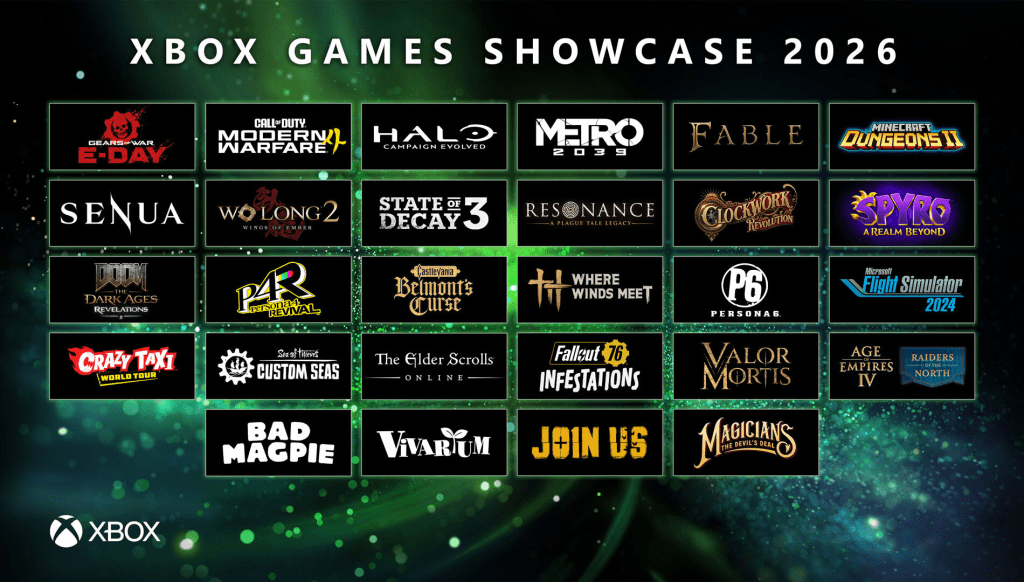
Yesterday was the Xbox Games Showcase 2026, and I came away from it with this thought: how much of this is actually new?
Headeliners were new entries from the long running franchises, and XBOX staples Fable and Gears of War: E-Day, alongside a somewhat controversial remake of Halo CE. These are beloved franchises. No argument from me on that. But Halo, Gears, Fable, and Forza all have something in common, they’re franchises that peaked, by most reckonings, over a decade ago. I don’t think that’s necessarily a problem. A genuinely good Fable game is something I’d play tomorrow. But leaning this heavily on nostalgia in what is supposed to be a 25th anniversary celebration of the platform does raise an obvious question: is this the Xbox of the next 25 years, or a reminder of the last 25?
Xbox called this showcase “a true celebration, offering world premieres, new gameplay, fresh updates and more.” That’s the kind of thing that gets said before every showcase. But was there enough here to give someone who doesn’t already own an Xbox a reason to buy one?
That’s the problem I keep coming back to. I live in the UK, and over here, PlayStation dominates XBOX. Walk into any major high street retailer or toy store and the PlayStation section is bigger, better positioned, and more prominently marketed. Sony sponsors sporting events that reach exactly the demographics who buy games consoles. The “For the Players” message is visible everywhere games are advertised. XBOX, outside of the enthusiast press, is largely invisible. Marketing budget is a boring thing to harp on, but I genuinely think it matters more than most of the strategic questions currently dominating the discourse. PlayStation has made themselves the default and Microsoft needs to work very hard to counter this narrative.
The multiplatform experiment
For the last couple of years, the framing from XBOX was that platform didn’t matter. Games would go everywhere, Game Pass was the differentiator, and the console was just one way to access the ecosystem. That didn’t work. It arguably made things worse. If your games are on PlayStation anyway, why buy an Xbox? The answer most casual consumers landed on was: don’t.
New CEO Asha Sharma has now acknowledged the tension directly, telling Bloomberg Tech.
“We’re increasingly becoming a platform, and in order to become a platform, you must have exclusive content and services.”
Whether this statement translates into actual exclusivity decisions on future releases is a different matter, and she was careful not to commit to specifics.
There’s a data point here worth paying attention to: Xbox console sales in the UK rose 15% while PlayStation fell 50%, attributable to Forza Horizon 6. A single exclusive game moved hardware.
The counterargument writes itself: Call of Duty sells 15-30 million copies a year across every platform. Pull it from PlayStation and you’re voluntarily walking away from the majority of those sales on a franchise that cost $69 billion to acquire. Sharma acknowledged this tension directly that being the second-largest publisher in the world means you need to sell to large audiences, and the economics of the biggest franchises simply don’t support exclusivity. So the answer is probably selective exclusivity: keep the tent-pole franchises multiplatform, pull back everything else.
Whether that’s enough to shift the narrative is another question.
The mandate
One thing worth noting about Sharma’s comments is the explicit rejection of the previous regime’s financial priorities. She’s been direct about it.
“My mandate is not 30% accountability margins. It’s to be the number one gaming and entertainment company.” That’s a genuine change in framing from the Phil Spencer era, when Xbox increasingly felt like it was managed as a financial exercise rather than a gaming brand”.
On her first 100 days, she said Xbox has “shipped more in the last 100 days than we have in the last year,” cited Game Pass returning to growth after an eight-month decline, and pointed to a closer relationship with the community as evidence of progress. Some of this is corporate speak. But Game Pass getting cheaper again was a real and welcome change given the cost of living crisis most people seem to be experiencing right now.
The Game Pass problem
This is where I think Xbox has a structural issue that games alone won’t fix. Game Pass is still probably the best value proposition in gaming on paper. An enormous library of games, day one first-party releases, for a monthly fee. In theory, that should sell itself.
In practice, the gaming landscape has shifted around it. Fortnite, Warzone, Roblox. These are free, they’re social, they’re updated constantly, and they absorb enormous amounts of player time without costing anything. If the people you’re targeting are already spending hundreds of hours in games that cost nothing, the appeal of “unlimited access to paid games” shrinks considerably. Game Pass makes more sense to someone who buys a lot of games than it does to someone whose entire gaming life is Fortnite and FIFA.
None of that is Xbox’s fault, exactly. But it means they can’t treat Game Pass as the silver bullet it was supposed to be. It needs to be part of a wider case for the platform, not the whole argument.
Project Helix
The next console, currently codenamed Project Helix, is presumably where all of this comes together or falls apart. Sharma has said that pricing pressure from the ongoing memory shortage driven largely by AI gobbling up available RAM supply is the big hardware challenge, and that the answer is innovation rather than price hikes:
“I think it’s expensive if we do not innovate. I came to help that problem.”
That’s an ambitious thing to promise. It’s also exactly what a new CEO would say before a launch. What matters is whether the hardware, when it arrives, gives people a reason to choose it over a PS6. On current trajectory, the honest answer is: not unless something changes.
The 25-year question
Here’s what I keep coming back to. Xbox has spent a lot of this anniversary leaning into nostalgia. The classic logo refresh, the retro marketing aesthetics, the roster of legacy franchises at the showcase. Some of that makes sense. Anniversaries are for looking back.
But the next 25 years of Xbox depend on reaching people who don’t have nostalgic feelings about Halo or the original green Xbox. People who grew up on PlayStation, or on mobile, or who are only now entering gaming. Those people are not going to be won over by a new Gears of War. They need something that makes Xbox the obvious choice for their gaming life.
Someone who grew up on PlayStation and currently spends their gaming time in Fortnite doesn’t care about any of this. Xbox needs a reason to exist for that person. Right now it doesn’t really have one.


Leave a comment