
For decades, the games industry has revolved around content: make a great game, market it well, and sell millions of units. But that supply‑side model is crumbling in a world where demand is governed by the attention economy, the finite pool of leisure minutes consumers parcel out across TikTok, Netflix, Roblox, and everything else competing for their eyes and thumbs.
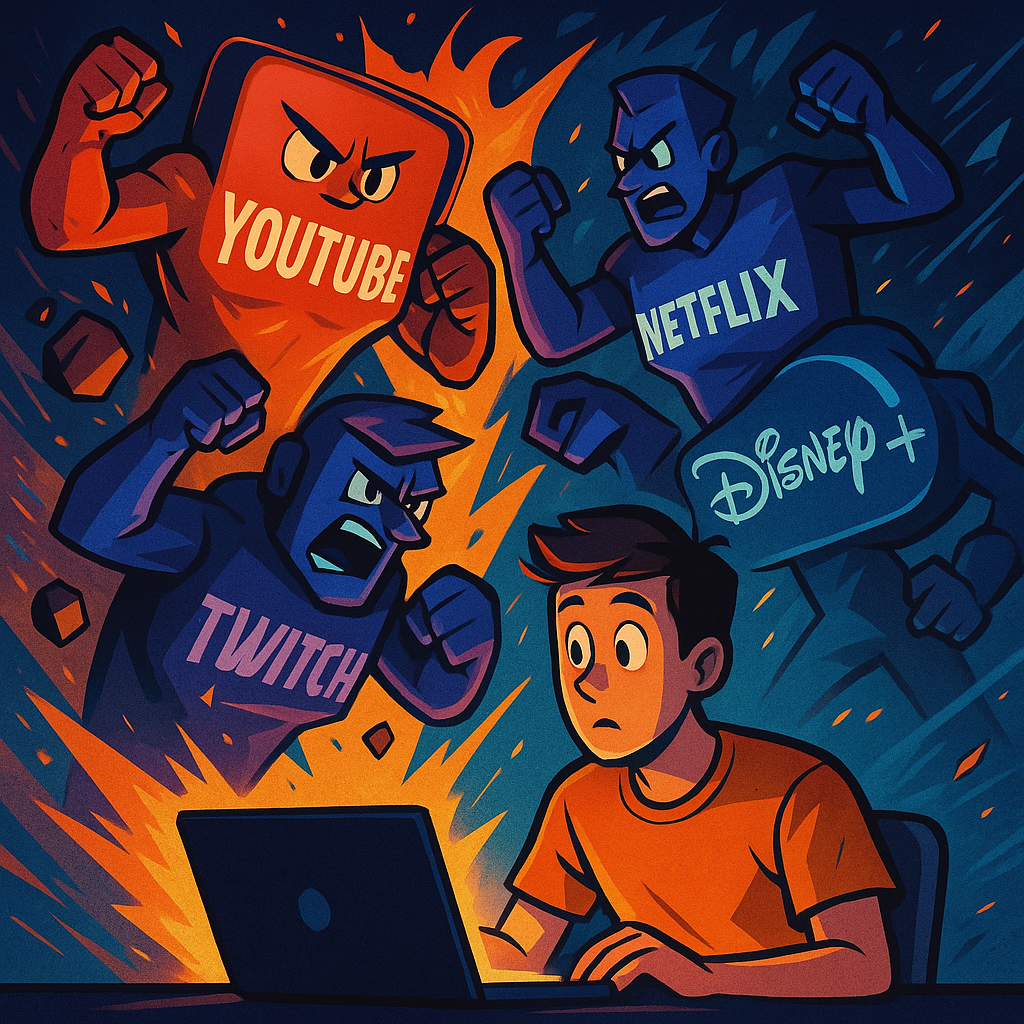
Former Square Enix executive Jacob Navok argues that we have entered an era where platform dynamics and Metcalfe’s Law, not sheer game quality determine who wins and who fades. In other words, success now hinges on capturing, recirculating, and monetising attention at scale. His detailed commentary on this shift offers a roadmap for understanding where games, AI, and the broader tech ecosystem are heading.
The Fall of ‘Content’ as King
Navok begins with a personal anecdote from his time at Square Enix, where he worked on translating annual reports. He observed a telling trend: the word “content” appeared 90 times in the 2004 report but only 28 times in 2024.
“We used the word ‘content’ a lot because we were in the content business. Square Enix has spent two decades slowly moving away from being a content business.” — @JNavok
The company, like much of the industry, has shifted from a product-oriented mindset to one focused on networks and player ecosystems.
What changed? Content scarcity flipped into attention scarcity. In the 1990s a great game could reliably command mind‑share because alternatives were limited; today players drown in options. A single TikTok session, a Netflix binge, or a Roblox spree can siphon away the time a boxed title once monopolised.

Metcalfe’s Law and the Platform Shift
At the heart of Navok’s thesis is Metcalfe’s Law: the value of a network is proportional to the square of its number of users.
“Games, AI, and tech are really part of the same network effect. Metcalfe’s law states that the value of a network is proportional to the square of the number of connected users.” — @JNavok
Games like Roblox and Fortnite aren’t just games, they are platforms, social spaces, and creative ecosystems. Their value grows exponentially with each new participant.
In an attention‑starved landscape, these network effects become attention magnets: the bigger the network, the more reasons users have to stick around, the harder it is for newcomers to lure them away.
Demand, Not Cost, Is the Crisis
Navok challenges the popular belief that bloated development budgets are the industry’s primary issue.
“We have a serious demand problem… A shorter FF17 is not going to make more demand.” — @JNavok
Games like Concord and Mindseye saw massive investments yet failed to capture significant audiences. The bottleneck isn’t production, it’s attention.
4. Fortnite vs Everyone Else: Platform Economics
Navok illustrates the economics with a simple but powerful example:
“With a larger player base and thus revenue base, Fortnite can outspend 99% of developers in the market.” — @JNavok
A game like Star Wars: Hunters can’t compete on content volume or live service quality. Players churn out quickly if they’re not continuously engaged.
Viewed through the attention‑economy lens, Fortnite buys loyalty by purchasing time, funding events, cross‑overs, and UGC contests that keep the feed fresh so players never feel compelled to look elsewhere.
AI’s True Role: Infrastructure, Not Just Art
AI isn’t just a content generator—it’s a strategic shift. Navok argues that Microsoft’s pivot to AI isn’t about replacing game artists but about staying relevant in the next wave of digital transformation.
“AI is a one-in-a-generation change in the entire digital order… Microsoft cannot lose at AI.” — @JNavok
Future platforms may allow users to generate their own experiences just by prompting an AI.
Crucially, AI‑driven personalisation can micro‑target content to individual tastes, maximising dwell‑time and making every session feel bespoke, an attention flywheel no traditional studio can match at scale.
The War for Time: TikTok, Roblox, and Attention
Today, time is the most limited resource, and competition is brutal.
“There is finite time in the day. If TikTok and gambling are growing, something needs to be reduced.” — @JNavok
TikTok, with its dopamine-driven feedback loop, directly competes with games for attention. Meanwhile, younger players are loyal to platforms like Roblox, which offer an infinite stream of creator-driven content.
7. Xbox, GTA6, and the Platform Imperative
Navok paints a bleak but realistic picture of AAA publishing:
“He [Strauss Zelnick] needs GTA6 to make its own gravity… to be on the shortlist of winners, cost be damned.” — @JNavok
With the market coalescing around a few dominant platforms, any game that doesn’t build its own gravitational pull may simply be forgotten.
In other words, AAA investments now compete in the same arena as social feeds: if a blockbuster can’t dominate daily discourse and streamer schedules, its window to earn back attention, and revenue, closes fast.
The Attention Economy: Scarcity of Time

Digital strategist Michael Goldhaber predicted as early as 1997 that “the currency of the new economy will not be money, but attention.” Twenty‑plus years later, TikTok’s infinite feed, Fortnite’s live events, and Roblox’s creator marketplace all demonstrate how time, not content is the true scarce resource.
Navok’s thread repeatedly underscores this reality:
“There is finite time in the day. If TikTok and gambling are growing, something needs to be reduced.” — @JNavok
In economic terms, every minute a player spends scrolling TikTok is a minute not spent in your game. Platforms that can capture and recirculate attention, via social graphs, user‑generated content, and algorithmic curation, win exponential mind‑share, while standalone products face a zero‑sum fight for whatever slivers remain.
Key Takeaways for Game Makers
| Attention Lever | Why It Works | Example |
|---|---|---|
| Network Effects | Social ties pull friends back daily | Fortnite squad play; Roblox friend graphs |
| UGC Flywheel | Players become creators, creating more reasons to stay | UEFN maps; Roblox experiences |
| Live‑Ops & Events | Scheduled scarcity drives FOMO | Fortnite concerts; GTA Online weekly bonuses |
| Algorithmic Discovery | Feeds surface long‑tail content that matches micro‑interests | TikTok’s “For You” feed; YouTube recommendations |
Design & Strategy Implications
- Design for Retained Attention, not First‑Week Sales
Shipping a great campaign is table‑stakes; the battle is won by how often players return. - Embed Creation Tools
If you don’t provide creative outlets, someone else will—taking your audience with them. - Leverage AI for Personalization
AI‑driven curation can surface niche content to keep every cohort engaged, mirroring TikTok’s rendement. - Think Cross‑Media
Your game competes not only with other games, but with podcasts, streaming video, and social media.
The bottom line: Metcalfe’s Law explains why platforms scale; the Attention Economy explains why that scaling matters. Together they shape a winner‑takes‑most landscape where capturing and continuously re‑earning a user’s attention is paramount.
Network Effects Rule and Attention Is the Prize
“Games are no longer a content business. Square Enix knows it too, but the sun set on their opportunity to transition to a Network business.” — @JNavok
This shift doesn’t mean traditional games will disappear but it does mean that the biggest successes will be those that treat attention as the ultimate scarce resource, architecting networks that capture, recycle, and expand it.
Metcalfe’s Law isn’t a future trend. It’s the reality already shaping the industry.
Sources
Jacob Navok’s original thread: https://x.com/JNavok/status/1942666471458628094
Additional commentary on Final Fantasy and demand: https://x.com/JNavok/status/1940883792493007092




 Twice the bits
Leave a comment