

…and the fall of games journalism
The state of games journalism leading to the latest debacle
Opinions and rumour are two a penny online. Small creators often deal in the tiniest rumour or speculation in order to generate clicks and more importantly conversation and engagement. They do this to make themselves relevant and to engage in what is probably a passion or hobby, speaking to like minded and similarly interested people. But where does this leave mainstream publications who are competing for the same eyeballs and attention span? In the case of IGN recently it left them looking at best uninformed, and at worst deliberately dealing in Trust Me Bro news for clicks.
What happened
So what actually happened? On a recent episode of the Xbox Era podcast Nick Baker was quoted as saying that he had received a DM stating that “Tatanka”, the rumoured Halo Battle Royale from Certain Affinity, has been cancelled. His Co-Host Jon Clarke goes on to say that Colt Eastwood had cited a similar source with the same information. The quote was picked up, and mangled somewhat, by Tom Phillips, the Editor in Chief at Eurogamer and reported in the following way.
“The mysterious, long-rumoured Halo battle royale project from series co-developer Certain Affinity is no longer in development, a report suggests.”
From <https://www.eurogamer.net/halo-battle-royale-reportedly-cancelled-after-years-of-work#comments>
Eurogamer the “first” to reveal what was said on a Podcast!!

IGN, sensing an opportunity for an easy story with a catchy headline reported on Eurogamers report with little in the way of critical analysis, investigation or even comment from Microsoft.
“An unannounced Halo Battle Royale was reportedly cancelled, according to XboxEra co-founder Shpeshal_Nick.”
From <https://www.ign.com/articles/unannounced-halo-battle-royale-reportedly-shelved>
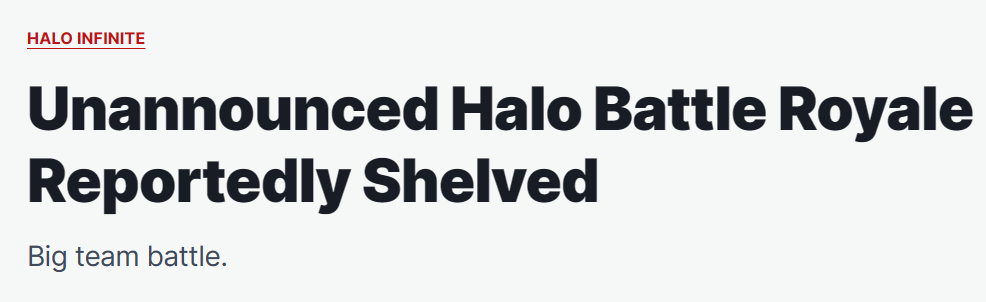
XboxEra have since issued a rebuttal to these nonsense headlines and actually come out of this sorry mess with a lot of credit. They posted links to the podcast in question, with timestamps so that we can all see exactly what was said. It appears that Nick at XboxEra had received a DM from a “source” so when ColtEastwood cited a source with the same information this became a point of discussion on the podcast. No more, no less and given all the weight that level of information deserves. That is to say, not a lot!
The XboxEra Podcast | LIVE | Episode 194 – “Direct me to the Lost Crown”
Their rebuttal goes on to say that –
What’s even more amusing is I even make a joke about overreactions to a rumoured game rumoured at being cancelled, and that “we don’t know – it’s just the scuttlebutt out there“. What’s really depressing in all of this is that we’re discussing someone else’s discussion, and all the headlines at the other end are effectively “Nick Baker reports Tatanka cancelled.” This is factually wrong. If we had corroborated, verifiable evidence and detail on this, I think it’s pretty likely we’d do a report ourselves. We don’t, so we haven’t. There’s a reason it’s just a discussion on the podcast.
They acknowledge the less than stellar credentials of these “sources” and put all of the noise around this project down to “scuttlebutt”.
Euro gamer eventually issued a retraction or edit of sorts but this, as you can imagine, garnered little attention, at least on Halo Twitter where the community is more than a little burned out by years of management failings, botched launches, and divisive TV adaptations.
In the case of IGN, this is a mainstream content platform with millions of subscribers across social media reporting on the rumoured cancellation, of a rumoured game, from another games website, citing speculation of rumours from another YouTuber on a podcast! The days of diligent investigative journalism and editorial restraint are long gone it would seem.
Let that sink in. No investigation, no official comment, no citing of sources to corroborate or dismiss the claims made. Just a couple of paragraphs outlining who said what and some vague background detail on other rumours of goings on at 343 and Certain Affinity, as if more words on the page somehow adds weight to whatever rumours are being treated as news today.
An over abundance of content and the rise of trust me bro news
“Never attribute to malice that which is adequately explained by stupidity”
Much of this sorry state of affairs can be attributed to the rise and inexorable rise of uncited sources, or Trust Me Bro news. Social media plays a large part in the rise with rumours and speculation being an active part of any healthy community. But when a member of that community states they have heard from “sources” that a new game is happening or the studio is changing to a new engine the oft heard refrain of “trust me bro, I got sources” is surely not too far behind. Now this is not to say that some of these creators, through their own work or just coincidence, might happen to know someone in the games industry who will pass them information. The problem for the audience is how much store can put in these sources. How much value are we deriving from the reporting we see? IGN, and other outlets like them, must strive to make clear where their stories come from and clearly mark rumours and general discussion as such. Dealing in vague language such “it has been reported that” and “ a report suggests” to hide behind the lack of verifiable sources is lazy at best and deceptive at worst.
Playing in to the rise of Trust Me Bro news where someone can say “I’ve heard this may be happening” which could mean anything from “I’ve got a friend who works at the studio” to “I read it on Reddit or Twitter” shows a lack of journalistic integrity and editorial restraint. It seems that as long as enough people repeat, discuss, debate or entertain a notion about a video game it is given credence. There may be some shred of truth behind these rumours but little substance beyond fan boy prattle. We have a here a case of the blogification of games media where opinions are printed or presented along side press releases and official news sources giving it weight simply by being under the IGN news banner.
How did we get here?
Money. Or to be clearer, funding models. News outlets are not only competing with each other but every gamer who, with a camera and a microphone, now has the ability to publish opinions, speculation and every other type of discussion around their chosen topic. They compete for eyeballs and impressions as a means to generate advertising revenue, leading to a need for a certain level of publishing cadence. The need to comment on every little story to maintain relevancy must surely impact editorial decisions as to what gets published and when. And what’s the penalty for publishing what they know to be rumour? Most immediately it’s a bunch of pissed off Halo boomers, but in the long term they erode the trust that is placed in their brand and become just another voice among many in the crowded field of internet gamer commentary.
Instead of being the voice of clarity, relied on by their audience to cut through the noise and offer a more considered and informed view, they become a punch bag for blogs such as this one. Reduced to a meme or playfull riff on their own logo. Trust Me Bro. I’ve got sources.
Where does this leave the developers and their audience
None of this helps game studios or their audience. Developers are under increasing pressure, with the cost of AAA game development rivalling and in many cases outpacing that required by Hollywood movies. Add to that the intense competition and unbelievable scrutiny online from social media and traditional news outlets and you have an industry which must at times, feel like working in a goldfish bowl. As for the audience games can be cancelled or significantly changed without ever having left the planning phase adding to a feeling of buyers remorse from gamers before they have even spent a dime.
Where does this leave IGN and game journalism at large
Competing with the TMB crowd on Twitter and YouTube provides no value to your readers and ultimately damages the brand who’s entire identity should be based on knowledge of, and access to, gaming insiders that TMB news simply cannot compete with.
Mainline publications find themselves with the unenviable position of having to compete with an endless barrage of “content”. They are playing the same algorithm game as the rest of us publishing online but by doing so they are trading away the one commodity amateur creators don’t have and that is old media credibility.
The printed word has always held power because news papers are hard to print at scale and even harder to distribute widely. Whilst the internet has solved the problem of distribution it has done so at the expense of a funding model that ensured publications held themselves to higher standards, lest they lose the trust of their audience. Lose that and you’ve lost everything.
By playing the engagement game, either for advertising revenue or relevancy is short sighted in the extreme. When you run with the herd, expect to get lost in the crowd.

 Twice the bits
Leave a comment